

Food Oral Immunotherapy (OIT): A Parent's Guide


In a nutshell: food oral immunotherapy
Food oral immunotherapy (OIT) is a specialist treatment that trains the immune system to tolerate an allergen by giving gradually increasing amounts under close medical supervision, building up to for example, 1 ½ peanuts or 120mls of milk.It does not cure food allergy, but it can significantly increase the amount of allergen a child can safely tolerate, raising their reaction threshold from tiny trace exposures to much larger amounts. This reduces the risk of severe reactions from accidental exposure. Evidence is strongest for peanut, egg, and milk allergy, and younger children tend to respond particularly well.
- OIT works by giving a child gradually increasing amounts of their allergen under medical supervision to raise the threshold at which a reaction occurs
- The goal is desensitisation: significantly reducing the risk of accidental exposure reactions, not a complete cure for most children
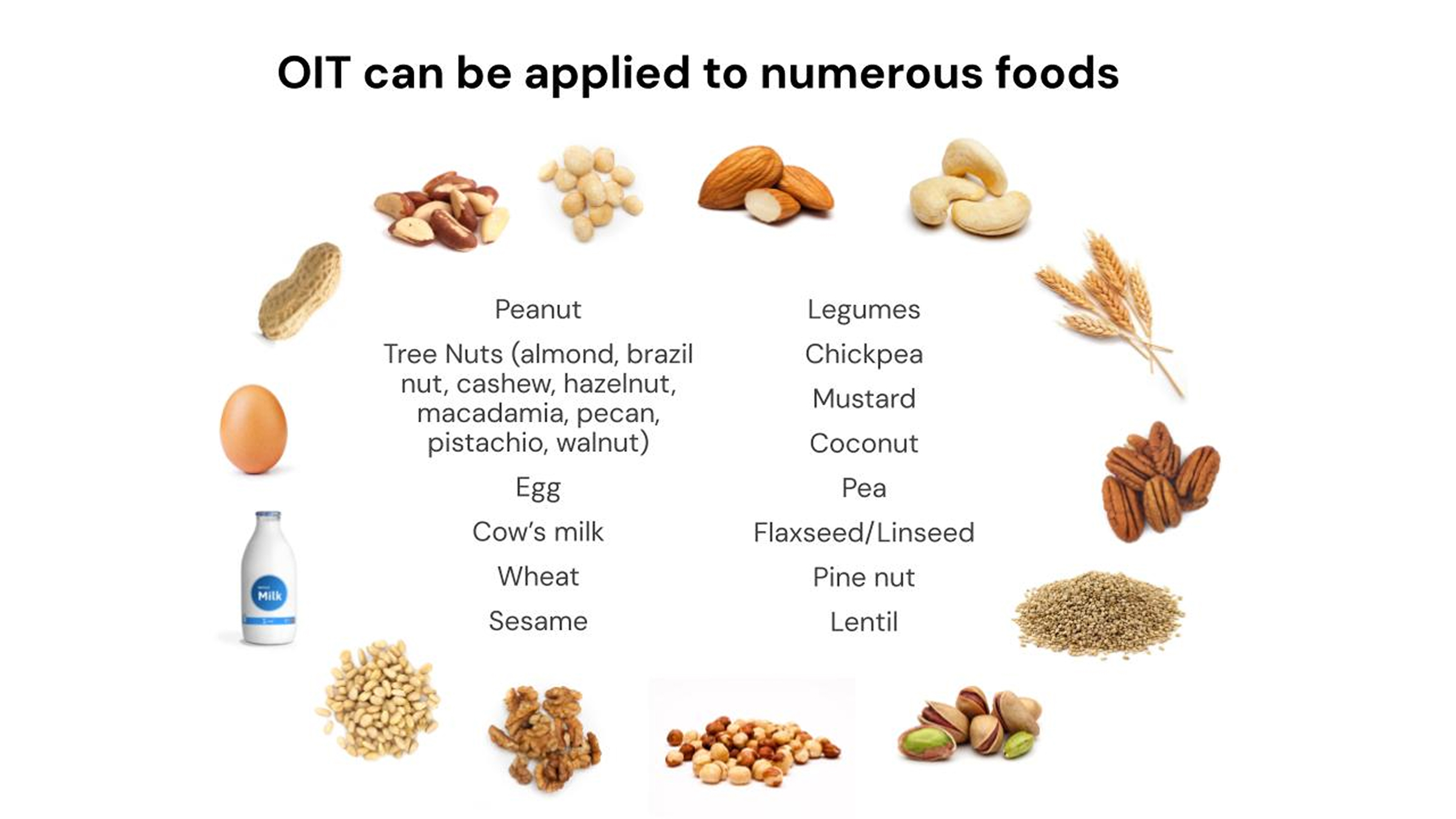
- Evidence supports OIT as an effective treatment for peanut, milk, and egg allergy in children. There is also increasing experience with sesame, tree nuts, legumes, wheat and other foods (see the table below)
- While this treatment is successful in children and adolescents, it can be even more successful when started early, in infancy and the toddler years. It is therefore valuable to assess suspected food allergies in early life.
- A thorough specialist assessment is essential before any OIT programme starts
What is food oral immunotherapy?
When your child is diagnosed with a food allergy, the immediate focus falls on staying safe: reading labels, avoiding the allergen, carrying an adrenaline device. For many parents, a second question follows not long after: is there anything that can actually treat the allergy, rather than simply managing it by avoidance?
For children with IgE mediated or ‘immediate’ allergies, the answer may be yes. Food oral immunotherapy, commonly known as OIT, is a specialist treatment that gradually introduces an allergen in small, carefully controlled doses to train the immune system to become less reactive. It won't erase an allergy entirely for most children, but it can make a significant difference to a child's daily safety and to the confidence of every parent who sends them out into the world.
If your child is under five, the timing of this conversation matters. Evidence suggests that younger children tend to respond particularly well to OIT, which makes early assessment and planning worthwhile even before a programme begins.
Food oral immunotherapy is a structured desensitisation programme. The principle is straightforward: regular, supervised exposure to small amounts of an allergen can, over time, change how the immune system responds to that food.
Treatment begins with a dose escalation phase, in which your child receives gradually increasing amounts of their allergen, typically mixed into food, at regular supervised clinic visits. In between these visits, they continue to take the same dose at home. Once a target dose is reached, your child takes a daily maintenance dose at home to sustain the effect.
There are two different possible outcomes, and it helps to understand them.
Desensitisation means that your child can tolerate the allergen whilst actively on the treatment programme. For most children, maintaining this protection requires continuing regular exposure to the allergen (eg. 1 ½ peanuts daily) over the long term. Desensitisation is the most common outcome, and for many families it is transformative: the acute fear of accidental exposure, at a birthday party, in a school canteen, or at a restaurant, is significantly reduced.
It is also possible to progress to a second stage where your child can achieve a higher daily intake, and in some cases, your child may no longer need to eat the food as frequently to remain protected.
What can OIT achieve?
The main goal of OIT is not to give a child freedom to eat their allergen freely. It is to raise the threshold of reactivity high enough that a small accidental exposure, a trace of peanut in a sauce, a biscuit made in a factory that handles milk, is unlikely to cause a severe or life-threatening reaction.
For some children, particularly when treatment is started early, an optional add-on treatment programme can help achieve a higher level of tolerance, allowing a less restricted diet. Whether this is suitable depends on the individual child and should be discussed with your allergy specialist.
The evidence base for peanut OIT is particularly strong: the 2024 EAACI guidelines on IgE-mediated food allergy issued a strong recommendation for peanut OIT in children and adolescents, reflecting high-certainty evidence of its effectiveness. The same guidelines also support OIT for egg and milk allergy.
For families living with the daily weight of a serious food allergy, this shift in safety margin can be genuinely life-changing. Many children who previously reacted to tiny trace amounts of peanut can, following successful treatment, tolerate the levels of accidental cross-contamination commonly encountered when eating out or attending social events. While continued caution and carrying adrenaline auto-injectors remain essential, this added protection can provide families with far greater confidence and freedom in everyday life.
Which allergens can be treated?
OIT has been studied and used most widely for peanut, egg, and milk allergies, which have the strongest evidence base and are the most commonly offered programmes. Treatment may also be available for tree nuts, wheat, sesame, and other allergens, with the range of options continuing to expand.
Can more than one food allergy be treated at the same time?
Many children are allergic to more than one food. In selected cases, multi-food oral immunotherapy (multi-OIT) may be an option, allowing more than one allergen to be treated within the same programme.
Whether this is appropriate depends on factors such as your child's allergy profile, age and the foods involved. Your allergy specialist can advise whether single-food or multi-food OIT is the safest and most effective approach.
Some foods are closely related and naturally cross-react with one another. This means that oral immunotherapy to one food may also provide protection against another closely related food. For example, OIT to cashew is highly likely to protect children who are also allergic to pistachio, while OIT to walnut usually also provides protection against pecan. As a result, most children with cashew, pistachio, walnut and pecan allergy would only require OIT to cashew and walnut to achieve protection against all four nuts. Your specialist allergist can discuss whether this strategy is suitable for your child
Is my young child a suitable candidate?
A specialist allergist will consider several factors when assessing whether OIT is right for your child.
Age is one of them. In general, younger children tend to be better candidates, and early intervention means more years of protection ahead.
Other factors your specialist will consider include:
- A confirmed diagnosis of IgE-mediated food allergy
- Whether your child has asthma, and how well it is controlled (poorly controlled asthma is a contraindication)
- Your child's reaction history and current allergy test results
- Their ability to cooperate with a supervised dosing protocol
- General health and any co-existing medical conditions
Because suitability varies from child to child, a thorough specialist assessment is the essential first step. No OIT programme should begin without one.
What are the risks and side effects?
Although OIT increases the amount of allergen that most children can tolerate, and greatly reduces the risk of reacting to an accidental exposure, it does not eliminate the risk of allergic reactions completely. Mild reactions during dose escalation are common and expected. These include oral tingling or itching, mild hives, stomach discomfort, or nausea shortly after dosing. Most resolve quickly and are manageable at home.
More serious reactions, including anaphylaxis, can occur but are uncommon when OIT is delivered under proper specialist supervision. This is why dose increases always take place in clinic with emergency facilities present, rather than at home. Severe reactions can however take place at home and families have to be prepared to use their emergency medications, including adrenaline devices, at home. It therefore remains essential to continue carrying prescribed adrenaline devices and to have an up-to-date allergy action plan both during and after the initial course of treatment and during maintenance. Your specialist will advise when this can be reconsidered.
It is also worth knowing that a small number of children develop a condition called eosinophilic oesophagitis (EoE) during treatment, a form of inflammation of the oesophagus that can cause symptoms such as difficulty swallowing. This typically resolves when treatment is paused or stopped, and is monitored throughout the programme.
Families are given clear guidance on managing home dosing, how to respond if a reaction occurs and circumstances that increase the risk of a reaction when your child is on the program, including exercise, illness, or missed doses. You will also be able to contact the clinic for support, if needed, between each clinic appointment.
Are there alternatives to oral immunotherapy?
Food oral immunotherapy (OIT) is currently the most established active treatment for food allergy, but it is not the only option.
Depending on your child's age, the foods involved, the severity of their allergy and your family's goals, your allergy specialist may also discuss:
- Sublingual immunotherapy (SLIT), where very small amounts of allergen are placed under the tongue. This may have fewer side effects than OIT but can take longer to achieve the desired level of protection.
- Biologic medications such as omalizumab, that modify the immune response. These may be used alone or alongside immunotherapy in selected children and are an area of rapidly advancing research and clinical practice. They have the potential advantage of simultaneously protecting against multiple food allergies. 2 injectable monoclonal antibodies have been licensed in the US to treat food allergies, but they are less widely available in the UK for this purpose.
- Standard avoidance and emergency management, which remains a safe and frequently used approach.
There is no single "best" treatment for every child. A specialist assessment helps determine which option—or combination of options—is most appropriate for your child's allergy, lifestyle and family circumstances.

When to seek specialist allergy advice
If your child has a confirmed IgE mediated food allergy, it is worth discussing OIT as part of your specialist consultation. Consider seeking an assessment if:
- Your child has had a severe or anaphylactic reaction to a food allergen
- Anxiety about accidental exposure is significantly affecting family life
- You want to understand all available treatment options and plan ahead
- Your child is under five and you want to think about OIT when it is likely to be most effective or before they reach school age
- Your child is approaching milestones such as school, travel, university/college or independent living, and you would like to explore whether OIT could help provide greater protection against accidental exposure and increased confidence in managing their food allergy.
- You are not yet sure whether your child's allergy is IgE-mediated and therefore potentially suitable for OIT
An early consultation means we can assess your child's full allergy profile, discuss the likely trajectory of their allergy, and begin planning the most appropriate path forward.
OIT at the LACK clinic
Our role is to provide a thorough specialist assessment to determine whether your child is a suitable candidate for OIT and to guide the most appropriate next steps. Where an OIT programme is indicated, we work closely with the Allergy Centre of Excellence (ACE), a specialist centre co-founded by Professor Lack.
Your child's treatment pathway begins with a complete clinical picture from our team. That assessment informs everything that follows, whether OIT is the right option, which allergen or allergens to focus on, and how to approach the programme safely given your child's individual history.
Speak to our team about whether OIT assessment is right for your child.
Frequently asked questions
At what age can my child start OIT?
There is no single minimum age for starting OIT. For peanut and many other food allergies, younger children can now be assessed for suitability, provided they are developmentally able to participate in the programme. For milk OIT, treatment is generally considered from around six years of age. Every child is different, and factors such as the type of allergy, overall health, and ability to cooperate with treatment are all considered. An allergy specialist can advise on the best timing for your child. As a general rule, younger children tend to be better candidates, so there is real value in seeking an early assessment.
Does OIT cure food allergy?
For most children, OIT achieves desensitisation rather than a permanent cure. This means your child can tolerate the allergen whilst they are actively on the programme, significantly reducing the risk of a severe reaction from accidental exposure. A smaller number of children, particularly younger ones, achieve sustained unresponsiveness, where tolerance continues even after the programme ends, with some young children opting to go on to programs that lead to less restrictive eating. Full, lasting tolerance is more likely in very young children.
How long does OIT take?
A typical OIT programme initially runs over 4-6 months for the build-up phase, with regular clinic visits for dose increases. Thereafter there is an ongoing maintenance phase during which your child takes a daily dose at home. Your specialist will give a more detailed timeline following assessment.
Is OIT safe for young children?
Mild reactions during dose escalation are common and expected. Severe reactions can occur but are less common and can be reduced with specialist advice . OIT should therefore only ever be undertaken under the care of an experienced allergy team, and pre-treatment assessment is essential to confirm your child is a suitable and safe candidate.
Will my child need to keep taking the allergen indefinitely?
Most children on a desensitisation programme continue daily maintenance dosing to maintain their protection. Some may progress to a stage where they are able to eat the food less frequently whilst maintaining tolerance. For selected younger children, a longer treatment programme may also be an option, with the aim of achieving greater tolerance and a less restricted diet. The specialist team will monitor your child's progress and advise on the long-term plan.
My child was recently diagnosed with a food allergy. Is it too early to ask about OIT?
Not at all. Early consultation is valuable precisely because younger children tend to respond better to OIT. Even if your child isn't ready to begin a programme immediately, an assessment will give you a clearer picture of their allergy, its likely trajectory, and what treatment options are available. It also means you are well-prepared when the time is right.
Will my child still need to carry an adrenaline auto-injector during or after OIT?
Yes. OIT reduces the risk of reactions from accidental exposure, but it is not considered a cure for most children. Children should continue to carry their prescribed adrenaline auto-injectors during treatment and, in most cases, afterwards as well. Your allergy specialist will advise if this can ever be reviewed based on your child's long-term progress.
Are there alternatives to oral immunotherapy?
Yes. Depending on your child's allergy, alternatives may include sublingual immunotherapy (SLIT), biologic medicines, or continued avoidance. Your allergy specialist will discuss which approach is most appropriate for your child.
Can several food allergies be treated at the same time?
Yes. Children with multiple food allergies may be suitable for multi-food oral immunotherapy (multi-OIT), although this is not appropriate for everyone. A specialist assessment is needed to determine the safest treatment plan.
Finding out if OIT is right for your child
A food allergy diagnosis in a young child brings understandable anxiety. OIT won't be the right option for every child, but for many it offers a meaningful step towards a safer, less restricted life. The right place to start is a specialist assessment that looks at the full picture. This is essential before any immunotherapy programme starts. It allows your allergist to confirm the diagnosis, determine whether OIT, SLIT, biologic treatment or standard management is most appropriate, and develop an individual treatment plan.
Concerned your child is affected by allergies?


